If you’ve been following along, you’ve already learned why your business’s reputation is your key to survival in the new AI-driven world of 2026. We established that AI agents will recommend businesses based on a 360-degree view of your customer sentiment online.
Knowing this, many smart business owners think: “Great! I need more reviews. I’ll make it easy.”
So, you go online, print a simple QR code, and tape it to your counter. When a customer scans it, it sends them directly to your Google Business Profile review page. (In fact, we offer a free tool for this on the RepOtz tools page because it’s a common first step.)
This seems like a good idea. But here is the hard truth: This strategy is one of the biggest, most damaging mistakes you can make.
You’re not managing your reputation; you’re playing roulette with it.
The Problem: Sending Everyone Through the Same “Public” Door
When you send 100% of your customers to your public Google review page, you are following a “hope and pray” strategy. You are hoping that every single customer who scans that code is 100% satisfied.
This is simply not realistic.
Think about it:
- The customer who had a great experience might leave you a 5-star review. That’s fantastic.
- The customer who is moderately happy (a 4-star experience) might not bother.
- But the customer who is unhappy—the one whose coffee was cold, whose package was late, or who felt the service was rude—is highly motivated.
You just gave your most frustrated customer a direct, public megaphone to vent to the entire world.
This is why so many businesses get stuck. You’re letting a few unhappy clients publicly damage your rating, making it nearly impossible to break past a 4.0 or 4.5-star average. Mathematically, it takes many 5-star reviews just to undo the damage of a single 1-star review. You are in a constant, uphill battle that you can’t win.
The “Google-Only” Blind Spot
Let’s assume you get lucky and most of your reviews are positive. You’ve still created a second, massive problem.
As we learned in our previous article, the AI agents of 2026 won’t just look at Google. They will perform a complete scan of your digital footprint to build a “trust score.”
When you send everyone only to Google, you are completely ignoring all the other platforms that build this trust:
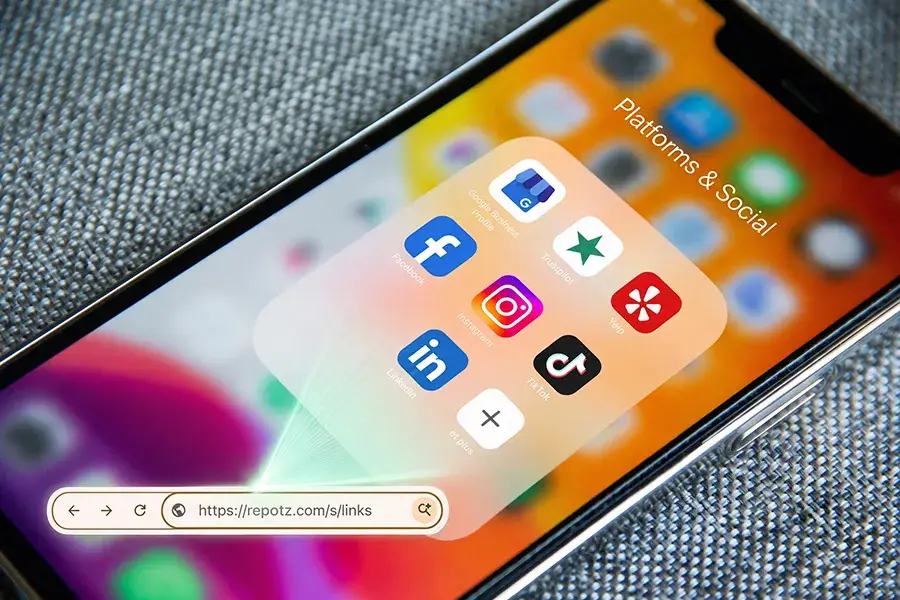
- Social Media Proof: Facebook, Instagram, and even TikTok are vital. An AI will see positive comments and user-generated content as powerful social proof.
- Industry-Specific Sites: Are you a restaurant? An AI will check Yelp and TripAdvisor. Are you an e-commerce brand? It will look for Trustpilot. A B2B service? It will check LinkedIn.
- General Trust: A business with 500 great reviews on Google but zero presence on any other platform looks suspicious or, at best, one-dimensional.
You are putting all your reputation eggs in one basket, and the AI agents of the future will see this as a massive blind spot.
Reminder: Your SEO is the “What,” Your Reputation is the “How Well”
This is a good time for a quick reminder. None of this means that your website or your traditional SEO (Search Engine Optimization) is dead.
Think of it this way:
- Your SEO (Your Website): This is your business’s “resume.” It must be well-structured so an AI agent can clearly read it and understand what you do, where you are, and what services you offer.
- Your E-Reputation (Your Reviews): This is your “reference check.” It tells the AI how well you actually do those things, based on real-world, unbiased customer feedback.
You absolutely need a clear, well-structured website. But that is just the foundation. Your reputation is what will make the final sale.
The Right Way: How to Actually Build Your Reputation
The goal should never be to just get reviews. The goal should be to hear from every customer, and to make it easy for the ones who want to post to do it where it counts.
This is what a true Reputation Optimization platform, like RepOtz, is designed to do. The “smart” approach is completely different:
- A customer scans one smart QR code.
- Instead of Google, it takes them to a simple, internal branded page that asks, “How was your experience today?”
- If they want to post publicly: the page presents a choice of platforms, Google, Facebook, Trustpilot and more, and the customer picks the one they prefer. That is how you build a strong, diverse profile across the entire web.
- If the experience fell short: the page offers the private feedback form first, because that is the fastest way to get the problem fixed. The public review option stays on the same page, and nobody is prevented from using it.
This simple change solves everything:
- The unhappy customer can tell you directly, while the problem is still fixable, and stays free to post publicly if they want to.
- You learn about a problem in your business and get a chance to fix it (and maybe even win that customer back).
- You hear from the customers who would otherwise have said nothing at all and simply not come back.
- Your happy customers are intelligently spread across all the platforms that AI will check.
How This Stays Compliant
RepOtz never filters reviews by rating. Both paths, the public review and the private message, are open to every customer on the same page, whatever they answer. Nothing is blocked, withheld or delayed based on how satisfied someone is.
That matters. Screening customers by sentiment so the unhappy ones never reach a public review site is called review gating, and it is prohibited both by Google’s review policies and by the FTC’s rules on consumer reviews. A platform that does it puts your listings at risk, not only your credibility.
Stop playing reputation roulette. It’s time to stop just collecting feedback and start optimizing it. In our next article, we will dive deeper into the tools and strategies that make this possible.