There was a time when reputation could be managed.
Businesses monitored reviews, responded to complaints, and tried to correct issues after they appeared. Reputation was something reactive, something you handled once it was already visible. That model worked when customers searched, compared, and took time to evaluate options.
That time is over.
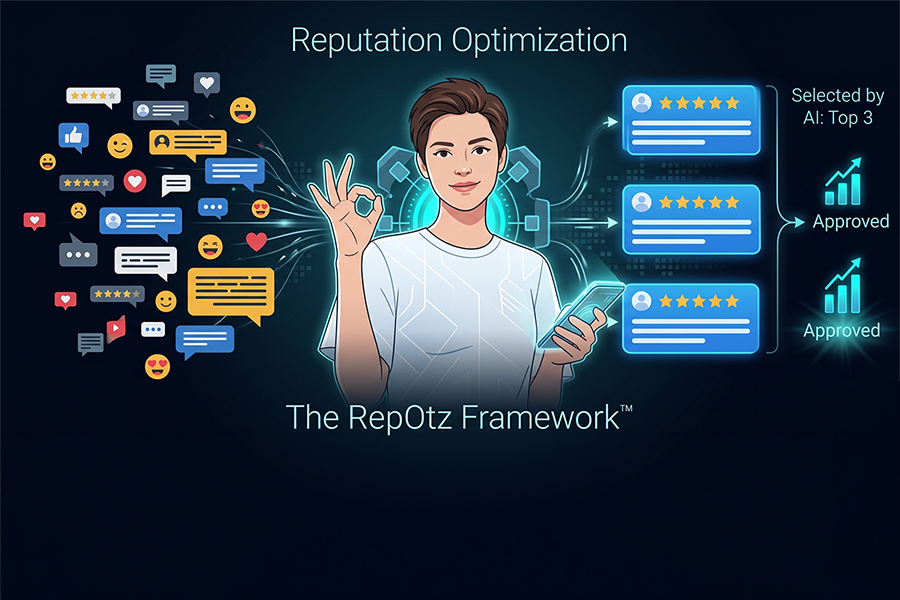
A fundamental shift has happened, and most businesses have not fully understood it yet. Customers no longer search the way they used to. They do not open multiple tabs, compare ten websites, and slowly narrow their choices. Today, they ask artificial intelligence. And AI does not present a list. It makes a selection. It recommends.
Often three options. Sometimes fewer.
If you are not among them, you are effectively invisible.
This shift changes the role of reputation entirely. For years, websites were considered the front door of a business. Traffic came through search, and the website did the work of converting. Today, that sequence has changed. Reputation now comes first. What exists about you across platforms, your reviews, your content, your presence, your signals of trust, has become the filter that determines whether you will even be considered.
Before someone visits your website, AI has already decided whether you deserve to be seen.
In that context, traditional reputation management reaches its limits. It was designed for a different era, one where visibility was broad and where reacting to issues could still protect a brand. But in a world where selection happens upstream, reaction is no longer sufficient. By the time a problem is visible, the decision may already have been made by a system that simply excludes you.
What is needed is not better management. It is a different approach altogether.
Reputation Optimization emerges from this new reality. It is not about controlling damage or responding to negative signals. It is about shaping how a business is perceived across the entire digital ecosystem so that it can be understood, trusted, and recommended by AI systems. It is proactive, structured, and continuous. It treats reputation not as a consequence, but as a system that can be designed.
This is the foundation on which the RepOtz Framework™ was built.
The framework was created (May 2025) by Hilaire Douanla (CEO of RepOtz) to answer a simple but critical question: how does a business become one of the few that AI chooses to recommend? The answer is not found in isolated actions or short term tactics. It requires a system that can observe, structure, influence, and continuously improve how a business appears across platforms.
The RepOtz Framework™ organizes this process into a coherent approach. It begins by diagnosing the current state of a business’s reputation across key dimensions, identifying both strengths and gaps. It then structures the presence of the business across platforms, ensuring consistency, control, and clarity. From there, it introduces a mechanism to intelligently route customer feedback in a way that is both effective and compliant, allowing positive experiences to strengthen public perception while negative ones are addressed constructively.
The process continues by amplifying the right signals, reviews, testimonials, and content that reinforce trust and credibility. It does not stop at visibility, but extends into monitoring, where perception is tracked in real time, allowing businesses to understand how they are seen at any given moment. Finally, it evolves through continuous optimization, adapting to changes, improving weak signals, and strengthening what drives recommendation.
This is not a campaign that starts and ends. It is an engine that runs continuously.
In this new environment, compliance is not a constraint. It is a requirement. Shortcuts such as fake reviews, manipulation, or attempts to bypass platform rules do not just fail. They actively damage trust. AI systems are built to detect patterns, and trust signals must be authentic to be effective. The RepOtz Framework™ is built on the principle that optimization must be compliant by design. Sustainable visibility can only be built on legitimate signals.
To explore how this system works in detail, you can visit: https://repotz.com/repotz-framework
What is ultimately changing is the objective itself. In the past, the goal was to be visible, to appear in search results, to attract attention. Today, visibility is only the first step, and often not the decisive one. The real goal is to be selected.
Search ranked pages. AI recommends entities. That distinction defines the new competitive landscape.
Reputation Optimization becomes the bridge between being present and being chosen. It transforms reputation from something passive into something engineered. It introduces a new layer in the digital strategy stack, alongside search engine optimization, advertising, and social media. It does not replace these elements, but complements them by addressing the question they do not answer: why one business is recommended over another.
If you want to understand the concept in depth, start here: https://repotz.com/reputation-optimization
Every major shift begins as a concept. Over time, it becomes a method. Eventually, it becomes a standard. Reputation Optimization is at the beginning of that trajectory.
The RepOtz Framework™ is an attempt to give it structure.
The future will not belong to those who simply appear. It will belong to those who are selected. To those who understood early that reputation is no longer something to defend after the fact, but something to design intentionally.
Reputation is the new front door. Optimization determines who gets through it.
Also published on Medium : Read the full story here.